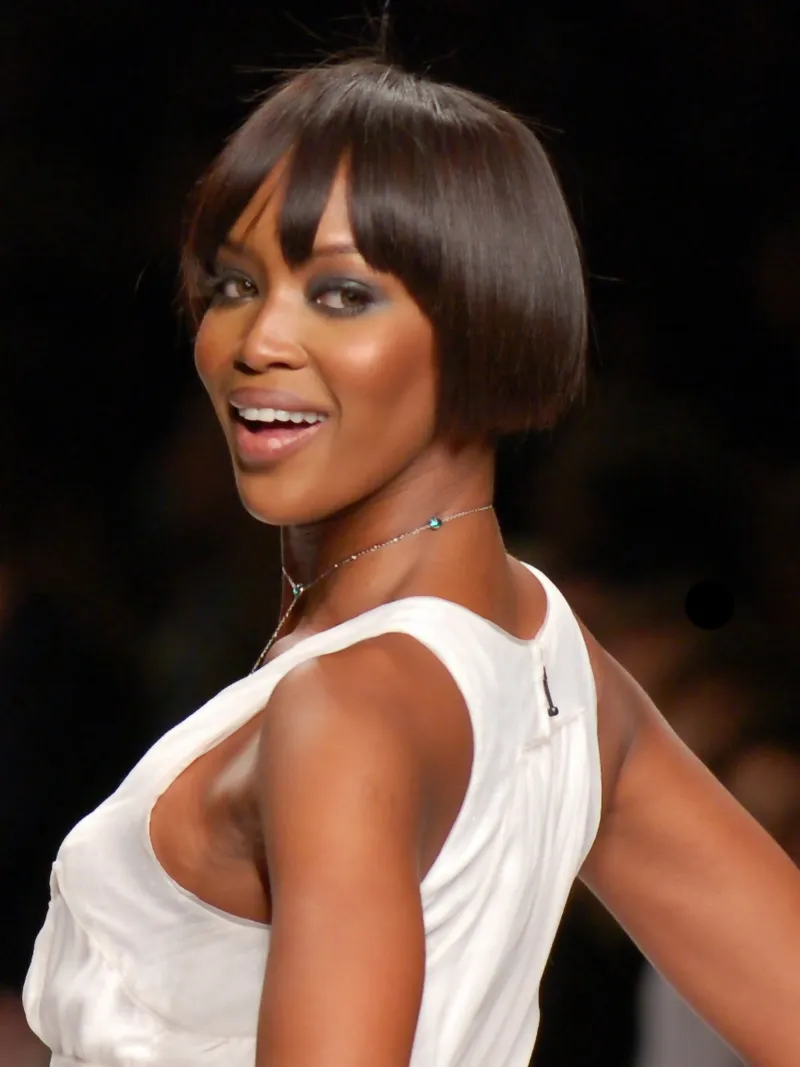
Naomi Campbell is not merely one of the great models of her generation — she is the woman who forced fashion to see her, and in doing so changed whom the industry was willing to put on its most powerful covers. She was the first Black model on the cover of French Vogue, the first on the all-important September issue of American Vogue, and the first Black woman to appear as a model on the cover of Time. In 2024 she became the first individual fashion model ever honoured with a solo exhibition at London’s Victoria and Albert Museum. For nearly forty years she has turned a runway career into a platform — for beauty, for temper, and above all for the long fight to make fashion less white.
A Streatham childhood and an early start
Naomi Elaine Campbell was born on 22 May 1970 in Streatham, in the south London borough of Lambeth. Her mother, Valerie Morris, was a Jamaican-born modern dancer who toured Europe; Naomi never met her father, who left before she was born. She is of Afro-Jamaican and Chinese-Jamaican descent, and spent part of her early childhood in Rome while her mother danced, raised in London by relatives in between. A performer from the start, she attended the Barbara Speake Stage School from the age of three and the Italia Conti Academy from ten, training in ballet, and appeared on screen as a child — in Bob Marley’s “Is This Love” video in 1978 and, aged twelve, in Culture Club’s “I’ll Tumble 4 Ya.” She was just fifteen, window-shopping in London’s Covent Garden in 1986, when a modelling scout stopped her on the street.
A career of firsts
Campbell’s rise was a sequence of barriers broken. In December 1987 she became the first Black cover star of British Vogue in two decades. In August 1988 she was the first Black model to cover French Vogue — a cover that, by widely repeated account, happened only because her friend and champion Yves Saint Laurent, one of the magazine’s most powerful advertisers, threatened to pull his advertising unless they featured her. In September 1989 she became the first Black model on the cover of American Vogue’s September issue, traditionally the year’s most important, on Anna Wintour’s first September cover as editor. And in September 1991 she became the first Black woman to appear as a model on the cover of Time. Each was a door that had been closed to models who looked like her, and each she pushed open.
The runway muse
On the catwalk she was a muse to the era’s titans — Gianni Versace, Karl Lagerfeld’s Chanel, Christian Dior, Alexander McQueen, John Galliano, Vivienne Westwood and Valentino — but none looked after her more closely than Azzedine Alaïa, who took her in when she first modelled in Paris and whom she called, simply, “Papa.” She belonged first to fashion’s “Trinity” with Linda Evangelista and Christy Turlington, and then to the “Big Six” supermodels rounded out by Cindy Crawford, Claudia Schiffer and Kate Moss — a phenomenon sealed when the supermodels lip-synced George Michael’s “Freedom! ’90” and then strode, arm in arm, down Versace’s 1991 runway. Nearly four decades on she has never stopped: in 2025 alone she opened Burberry’s autumn show at London Fashion Week, walked in Milan and starred in the Emilio Pucci campaign.
Activism and impact
Campbell has used her standing to fight for diversity since the 1980s, when she joined the Black Girls Coalition. In 2013 she co-founded the Diversity Coalition with Bethann Hardison and Iman, publicly naming fashion houses that used “one or no models of colour” and declaring that, whatever the intention, “the result is racism.” In 2005 she founded the charity Fashion for Relief, staging benefit shows for causes from Hurricane Katrina to the Haiti earthquake; the charity later became the subject of a UK Charity Commission inquiry, which in 2024 found mismanagement and disqualified her as a trustee — a finding she has indicated she may appeal. In 2018 she received the CFDA’s Fashion Icon Award.
The Private Side
Campbell became a mother later in life and guards her children’s privacy fiercely. She announced a daughter in May 2021, at fifty, and a son in June 2023, at fifty-three, each revealed quietly on Instagram, and in 2024 she confirmed that both had been born via surrogate — framing the decision as encouragement to other women while declining to say more. Her widely reported past relationships include the boxer Mike Tyson, the U2 musician Adam Clayton, the businessman Flavio Briatore and, her best-documented long-term partnership, the Russian developer Vladimir Doronin, with whom she was together from around 2008 to 2013. As of 2026 she has not publicly confirmed a current partner.
Earnings and net worth
After four decades at the top of her field, Campbell is among the wealthiest models of her era. Wealth trackers such as Celebrity Net Worth estimate her fortune in the tens of millions of dollars, though figures vary widely by outlet and trace to net-worth aggregators rather than any audited or officially confirmed source — they are best read as unofficial estimates. Contrary to a persistent myth, the famous “we don’t wake up for less than $10,000 a day” line belonged to her friend Linda Evangelista, not to Campbell.
Where she is now
In 2024 the Victoria and Albert Museum staged “NAOMI: In Fashion,” the museum’s first exhibition ever devoted to a single model, displaying around a hundred looks across her career alongside her decades of activism. Now in her mid-fifties, she remains a working model and an immovable front-row fixture — proof that the girl stopped on a Covent Garden street corner became not just a supermodel but one of the most consequential figures fashion has ever produced.