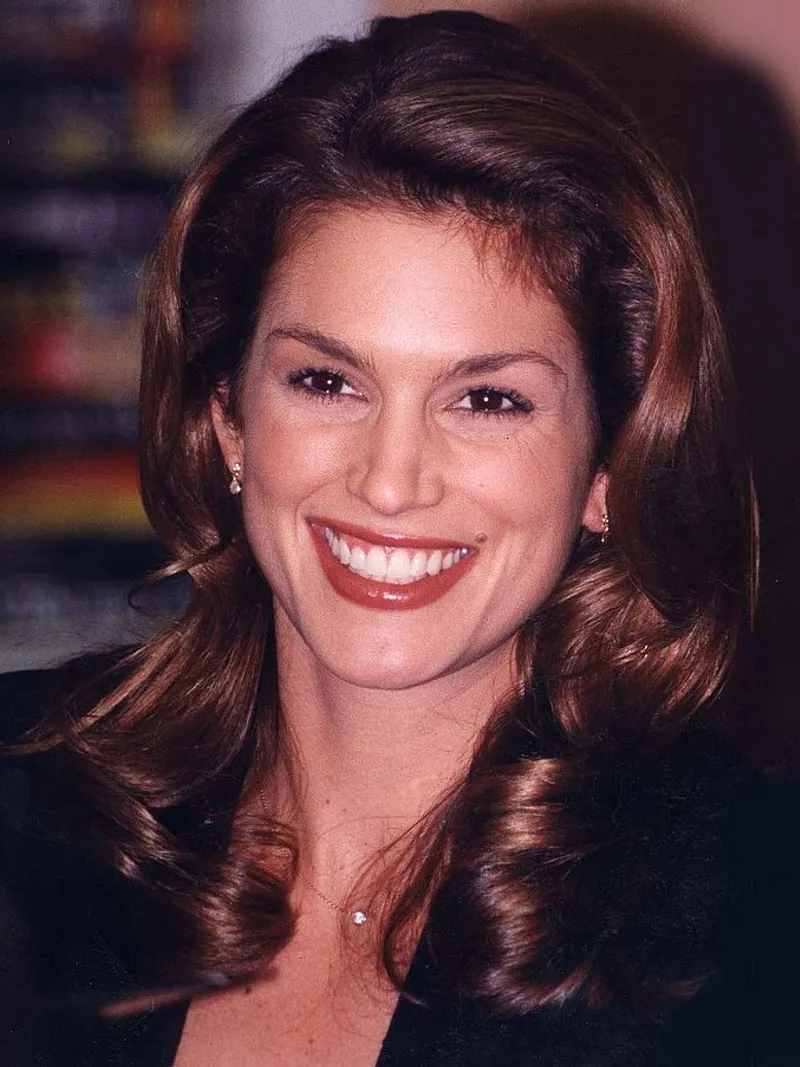
If the 1990s had an official face, it belonged to Cindy Crawford. The all-American brunette with the beauty mark above her lip did something none of her peers managed quite so completely: she carried high fashion out of the studio and into vending-machine commercials, gym VHS players and Saturday-morning television, becoming a household name to millions who had never opened a copy of Vogue. More than a model, she was the one who proved a beautiful face could also belong to a shrewd businesswoman — and she built a skincare empire to make the point.
A valedictorian from a DeKalb cornfield
Cynthia Ann Crawford was born on 20 February 1966 in DeKalb, Illinois, a farm town outside Chicago, the daughter of an electrician and a bank teller. Hers was not a glamorous childhood, and it held an early tragedy: the death of her younger brother, Jeffrey, from leukemia at the age of three. Cindy was as much a scholar as a beauty. She graduated from DeKalb High School in 1984 as class valedictorian and won an academic scholarship to study chemical engineering at Northwestern University — then lasted a single quarter before the pull of modeling won out and she left to pursue it full-time. It was a gamble that would define her life.
From detasseling corn to Elite
Her discovery is pure American heartland. As a teenager she spent a summer detasseling corn on a local farm, and a photographer noticed her — the first step on a path that led, in 1986, to New York and a contract with Elite Model Management. Within a few years she had become the most bankable model in the business.
The work: Pepsi, the runway and the rise of the supermodel
Crawford’s defining commercial moment arrived on 26 January 1992, when her Pepsi advertisement debuted during Super Bowl XXVI. In it she steps out of a red sports car at a dusty roadside café in a white tank top and denim cut-offs; two young boys watch, agog — at the can, the joke goes. The spot is still routinely ranked among the greatest Super Bowl commercials ever made. By then she was already a television fixture in her own right, having hosted MTV’s House of Style from 1989 to 1995, a show that translated runway fashion for a young pop audience.
On the catwalk, Crawford was one of the “Big Four” supermodels alongside Linda Evangelista, Naomi Campbell and Christy Turlington. Their reign was crowned at Gianni Versace’s autumn 1991 show, where the four strode arm-in-arm down the runway lip-syncing George Michael’s “Freedom! ’90” — the moment fashion and pop culture fused. In print she was inescapable: she shot her first American Vogue cover in 1986 and went on to land, by most counts, around eighteen Vogue covers across editions, alongside headline contracts with Revlon, Pepsi and Maybelline.
The model who became a mogul
Crawford understood the value of her own image earlier than almost anyone. In 1992 she released the fitness tape Shape Your Body Workout, which The New York Times would later call the best-selling single fitness video of all time. Forbes named her the world’s highest-paid model in the mid-1990s. But her most durable venture came in 2005, when she co-founded the skincare line Meaningful Beauty with the cosmetic dermatologist Jean-Louis Sebagh — a brand she half-owns and which reportedly grosses more than $100 million a year. In treating her face as an asset to license and ultimately own, she wrote the template a later generation of model-entrepreneurs would follow.
The first crossover supermodel
What set Crawford apart from even her “Big Four” peers was sheer reach. By the mid-1990s she was arguably the most recognizable model on earth — her face moved magazines, her annual swimsuit calendars sold in the millions, and her name registered with people who had never once followed fashion. She moved fluidly between worlds that had rarely overlapped: haute-couture runways in Milan and Paris on one side; MTV, Super Bowl Sunday and the home-video aisle on the other. She was beamed into living rooms as comfortably as she appeared on glossy covers, and that duality — high fashion and mass culture at once — was something the industry had simply never produced on her scale before. More than any single campaign, it is why she is remembered as the model who pulled high fashion into the mainstream and never let it leave.
The Private Side
Crawford’s private life has proved far steadier than the tabloid 1990s might suggest. She married the actor Richard Gere in 1991; the couple divorced in 1995. In 1998 she married the nightlife and tequila entrepreneur Rande Gerber, and the two have been together since, raising two children — son Presley (born 1999) and daughter Kaia Gerber (born 2001), now a sought-after runway model in her own right and frequently noted for her resemblance to her mother. The family has cultivated a notably low-drama public profile, and Crawford has long described her marriage as a genuine partnership.
Earnings and net worth
As the model who pioneered the face-as-brand, Crawford ranks among the wealthiest figures her industry has produced. Wealth trackers such as Celebrity Net Worth estimate the fortune she shares with Rande Gerber in the hundreds of millions of dollars, much of it built on her ownership stake in Meaningful Beauty — though such numbers are unofficial, combined estimates rather than audited figures. What is documented is the trajectory: from record-setting paydays at her commercial peak to a business that long outlasted the runway.
Where she is now
Now in her late fifties, Crawford has stepped back from full-time runway work but remains a constant brand presence — fronting and owning a major stake in Meaningful Beauty, appearing in the occasional editorial and throwback campaign, and taking a central role in the 2023 Apple TV+ docuseries The Super Models alongside Campbell, Evangelista and Turlington. With daughter Kaia keeping the family name on current runways, the supermodel who once left engineering school for a long-shot career has become something more durable than a 1990s icon: a businesswoman whose face still sells.