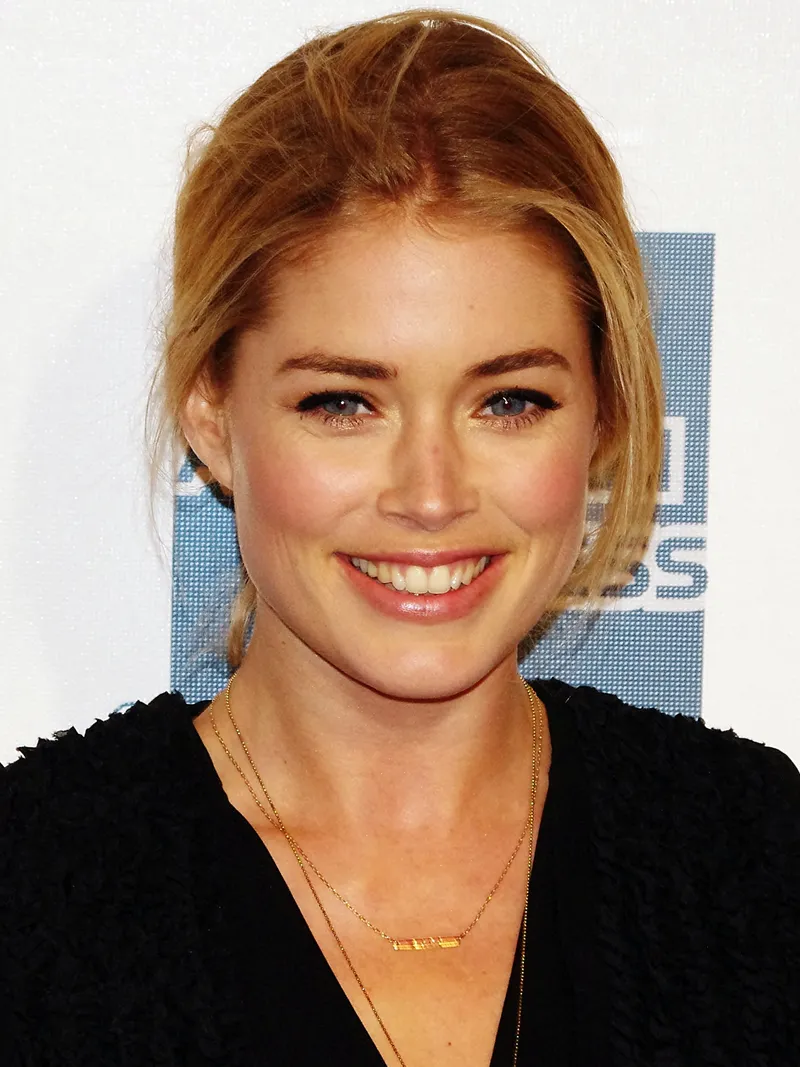
She is, by one accounting, the only model in history to land four solo international Vogue covers in a single month — and she did it without ever quite shedding the down-to-earth air of a girl from a Friesland village who, by her own account, would rather have been a speed skater. Doutzen Kroes turned a set of amateur snapshots into one of the most lucrative and enduring careers in modern modelling: a Victoria’s Secret Angel, a decade-and-a-half L’Oréal Paris face, a fixture on Forbes’ highest-paid lists, and, latterly, a globe-trotting elephant-conservation campaigner.
Speed skates before stilettos
Doutzen Kroes was born on 23 January 1985 in Eastermar, a village in the northern Dutch province of Friesland. She is Frisian — Frisian, not Dutch, was the first language of her childhood — and skating, not fashion, was the family business: both of her parents had been champion speed skaters, and the young Doutzen fully intended to become a professional skater herself before the industry intervened. Around 2003 she sent personal snapshots to an Amsterdam agency, was signed, and within a few years had moved up to a top New York agency and an international career she had never planned.
The work: snapshots to supermodel
Her breakout came fast. In May 2007 American Vogue, shot by Steven Meisel, ran its celebrated “The World’s Next Top Models” foldout cover, anointing a cohort of rising stars that included Kroes alongside Sasha Pivovarova and others. Victoria’s Secret cemented her fame: she was a contracted Angel from 2008 to 2014, only the second Dutch model ever to earn the title. Running parallel to the lingerie work was the partnership that arguably defined her commercial value — L’Oréal Paris, for whom she has been a brand ambassador since 2006, one of the longest-running beauty-house relationships in the business. Her portfolio grew dense with blue-chip names: Calvin Klein fragrances, Tiffany & Co., Gucci, Versace, Valentino and more. The crowning editorial feat came in September 2013, when she became the first model ever to land four different solo international Vogue covers in a single month.
That September 2013 feat — four solo international Vogue covers at once — was the kind of statistic that does not really repeat. It required a face that worked across markets and aesthetics simultaneously, recognisable enough in New York, Paris, Tokyo and her native Europe to anchor each edition’s most important issue of the year. It was the clearest possible measure of how completely she had crossed over from promising newcomer to global commercial force, and it remains a record few models will ever approach.
Within Victoria’s Secret she became one of the brand’s most recognisable Angels of its late-2000s heyday, walking its televised shows when they were among the most-watched spectacles in fashion. And her L’Oréal partnership proved extraordinarily durable: where most beauty contracts last a season or two, hers stretched across more than fifteen years, making her one of the most familiar faces in the world’s shops and department stores. Few models have combined runway glamour and mass-market beauty reach for so long — and that combination, more than any single campaign, is what made her, for a stretch, one of the best-paid models alive.
A broader idea of beauty
Kroes belonged to the small generation of “post-supermodel” faces who bridged the runway and the global advertising machine. Distinguished early on by a fuller, more athletic figure than many of her contemporaries, she became a quiet symbol of a slightly broader beauty ideal within high fashion — proof that the most lucrative campaigns in the world did not all have to go to the same narrow silhouette. Her Frisian roots, her candour about her skating-family background, and her later pivot to conservation gave her a public identity that reached well beyond the catwalk.
Knots and elephants
Kroes’s signature cause is elephant conservation. In 2016 she became the global ambassador of #KnotOnMyPlanet, the campaign supporting the Elephant Crisis Fund, rallying fellow models and celebrities to fight poaching and the ivory trade; she also sits on the advisory body of Save the Elephants and has spent time at its Elephant Watch Camp in Kenya. By the organisation’s account the campaign has helped raise more than three million dollars for the cause. Earlier in her career she was active with Dance4Life, which uses song and dance to educate young people about HIV prevention — the beginnings of a public life she has increasingly built around causes rather than campaigns.
The Private Side
Kroes married the Dutch DJ Sunnery James Gorré on 7 November 2010, in her home village of Eastermar. The couple have two children, a son, Phyllon Joy, born in 2011, and a daughter, Myllena Mae, born in 2014, and have largely kept their family life out of the spotlight even as both parents built public profiles — he in dance music, she in fashion and conservation. By all accounts the marriage is ongoing, and Kroes has spoken of her family and her Frisian home as the ballast that kept a globe-trotting career grounded.
Earnings and net worth
Kroes was, for years, among the best-paid models alive. Forbes’ annual rankings tracked her steady climb, peaking in 2014, when she placed second — tied with Adriana Lima — at an estimated eight million dollars for the year, a haul Forbes attributed to her L’Oréal and Victoria’s Secret contracts and her fashion campaigns. Her overall net worth is harder to pin down: celebrity-finance trackers and Dutch business press have published figures that differ markedly from one another, and all of them are unofficial estimates rather than audited numbers, best read as ballpark rather than fact.
Where she is now
After Victoria’s Secret revived its fashion show, Kroes returned to the runway, walking the 2024 edition and again in October 2025 — reportedly her ninth VS show — in dramatic gold wings alongside alumnae including Adriana Lima, Candice Swanepoel and Behati Prinsloo. Two decades after a handful of snapshots changed her life, she continues to combine selective modelling with the conservation and wellness work that has become the second act of a career few Frisian speed-skating hopefuls could ever have imagined.