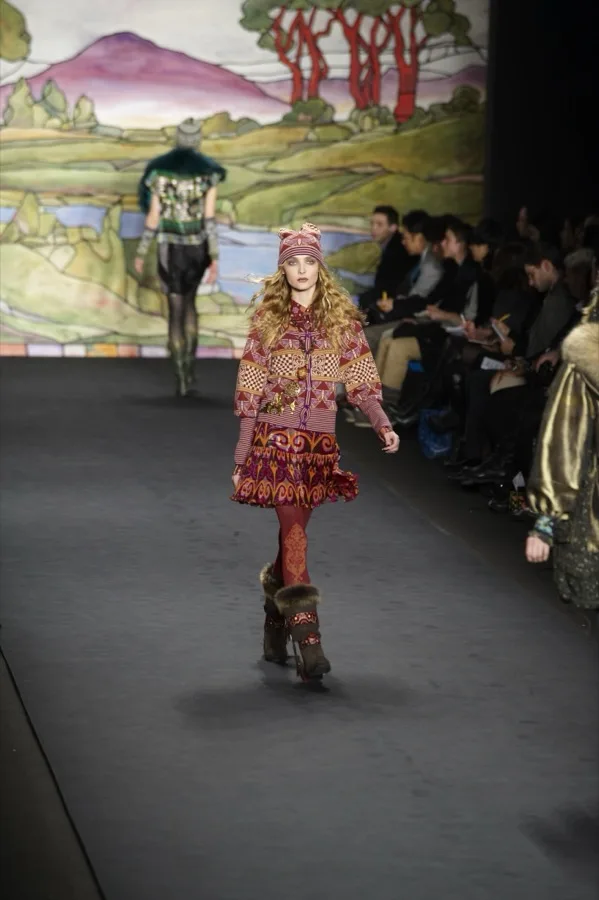
Snejana Onopka (Снежана Онопко) is a Ukrainian model who, for a few electric seasons in the mid-2000s, was the single most recognizable new face in fashion. Born in Severodonetsk in 1986 and stopped by a scout in Kyiv as a teenager, she was pulled into the orbit of the photographer Steven Meisel in 2005 and became, almost overnight, the defining image of an entire aesthetic — pale, remote, impossibly slender, with a stare that seemed to look straight through the lens. She opened and closed the biggest shows in Milan, Paris and New York, fronted campaigns for Prada, Dolce & Gabbana, Louis Vuitton, Calvin Klein and Yves Saint Laurent, and put her face on two covers of Vogue Italia in a single year. Two decades on she remains one of the most quietly influential runway models of her generation.
From Severodonetsk to a Kyiv casting
Onopka was born on 15 December 1986 in Severodonetsk, an industrial city in eastern Ukraine. Hers was not a fashion family in any obvious sense — her father played in a rock band while she was growing up, which, she has joked, at least left him comfortable around attention. As a teenager she moved to Kyiv, and it was there, at around fifteen, that a foreign scout stopped her. Tall, fair, blue-eyed and startlingly thin, she had exactly the proportions that international agencies were beginning to hunt for.
The early steps were unglamorous. She signed first with a local Kyiv agency, and by 2004 was represented by AL Model Management, which had a working link to New York's DNA Model Management. She has been candid that she almost didn't last. Arriving in New York with no English, she spent her days silent and homesick, wondering whether she had crossed an ocean for nothing. "I was thinking — do I need all this?" she later recalled. What kept her there was a piece of pure luck.
2005: the year Meisel changed everything
By her own account, the turn came when she lost her passport. Stuck in New York waiting for a replacement, she filled the empty days with castings — and one of them was for an assistant to Steven Meisel, the most powerful fashion photographer of the era and the man who effectively decided which new girl each season would belong to. Test shoots followed, and within a couple of months she was booked for a Dolce & Gabbana campaign shot by Meisel himself. She remembers being terrified on set: he barked directions at everyone in the room and said not a single word to her. She was sure she had failed. She had, in fact, done exactly what he wanted.
The Dolce campaign was the first domino. In 2005 Meisel also shot her for Prada's autumn advertising and placed her on two covers of Vogue Italia, the industry's ultimate stamp of approval, in quick succession. A booking frenzy followed. That September she announced herself on the runways by closing Marc by Marc Jacobs in New York and opening Dolce & Gabbana, and the momentum carried straight into the next year: 2006 brought campaigns for Calvin Klein, Louis Vuitton and Yves Saint Laurent, and the role of house face at Lanvin. For a model who a year earlier had been ready to fly home, it was a vertical ascent with almost no parallel at the time.
The range of what followed is easy to underestimate now. She walked for Chanel, Gucci, Christian Dior, Versace, Balmain, Marc Jacobs and Isabel Marant, and her face carried the covers of i-D, Numéro, W, Harper's Bazaar and L'Officiel as well as the Italian, French and Japanese editions of Vogue. In her first seasons her schedule was punishing — dozens of shows in a matter of weeks — and casting directors treated her as one of the most sought-after new mannequins in the business. Within a single calendar year she had gone from an anonymous arrival to a girl the biggest houses built their opening and closing looks around.
The face of an aesthetic — and its backlash
Onopka did not just succeed during the mid-2000s; she came to embody its most divisive idea. This was the height of the so-called "size-zero" period, when the fashionable runway silhouette narrowed to an extreme, and her slight frame and hollow-cheeked look made her its most photographed example. That visibility cut both ways. In September 2006 a New York Times report, "When Is Thin Too Thin?", named her among a small group of models whose extreme thinness had drawn audible gasps from show audiences and helped push the debate about runway health into the mainstream.
It is a difficult chapter to write about honestly, because it was an argument about a very young woman's body conducted largely without her. What is fair to say is that Onopka became the visual shorthand for a standard the industry itself would spend the following years questioning and, in places, regulating. She kept working through all of it, and the conversation she was placed at the center of outlasted the trend that created it.
The "ice queen" and the walk
What made her more than a passing look was presence. On the runway Onopka was unsmiling, glacial and completely self-possessed — an attitude the press liked to sum up as the manner of an "ice queen." Her stride even earned a place on a published ranking of fashion's best runway walks, filed under the blunt nickname the "I don't give a f***" walk, a distinction she recounts with obvious pride.
Off the runway, though, the famous blankness turns out to be less pose than temperament. "I don't understand why I should smile if I don't like something," she once explained. "I just have sad eyes. They were given to me by nature." She has described being called "a monster" even at her own agency, on the grounds that every mood shows on her face and she cannot hide any of it — the same transparency that read, under studio lights, as mystery. She belongs firmly among the defining supermodels of the 2000s, and among the wave of Eastern European models who reshaped the runway in that decade.
Stepping back, and a quieter life
At the peak of her fame Onopka was as known for her candor as for her cheekbones, and she has since wondered whether it cost her. "If I hadn't made some mistakes and talked less, I would be a second Kate Moss," she reflected years later — a rare admission of ambition from someone who mostly guarded her privacy. In 2011 she married the Ukrainian businessman Mykola Shchur and gradually pulled back from the relentless show schedule; the marriage ended in divorce in 2020.
She never fully disappeared. In 2012 she fronted the Tom Ford Beauty campaign, and in the years that followed she returned to selected runways and projects, including a 2021 art project by Alex Luna, "Somnia Disaster," marking the thirty-fifth anniversary of the Chernobyl disaster. In 2022 she relocated to Riga, Latvia, where she has built a markedly more private life, largely out of the industry spotlight, and in 2024 she announced that she had remarried. She is fluent in Ukrainian, Russian and English, and remains, by temperament, someone who would rather say too little than too much.
Frequently asked questions
Where is Snejana Onopka from?
She was born on 15 December 1986 in Severodonetsk, Ukraine, and moved to Kyiv as a teenager, where she was first scouted.
What is Snejana Onopka best known for?
Her 2005 breakthrough with photographer Steven Meisel — the Prada and Dolce & Gabbana campaigns and two Vogue Italia covers — and for becoming the defining runway face of the mid-2000s "size-zero" aesthetic.
Why doesn't she smile in her photos?
She has said her blank expression is natural rather than an act: "I just have sad eyes. They were given to me by nature."
Is Snejana Onopka still modeling?
She stepped back from full-time runway work after 2011 but never retired outright, returning for selected campaigns and projects; she now lives a largely private life in Riga.
Where does Snejana Onopka live now?
In 2022 she relocated to Riga, Latvia, where she keeps a low public profile.