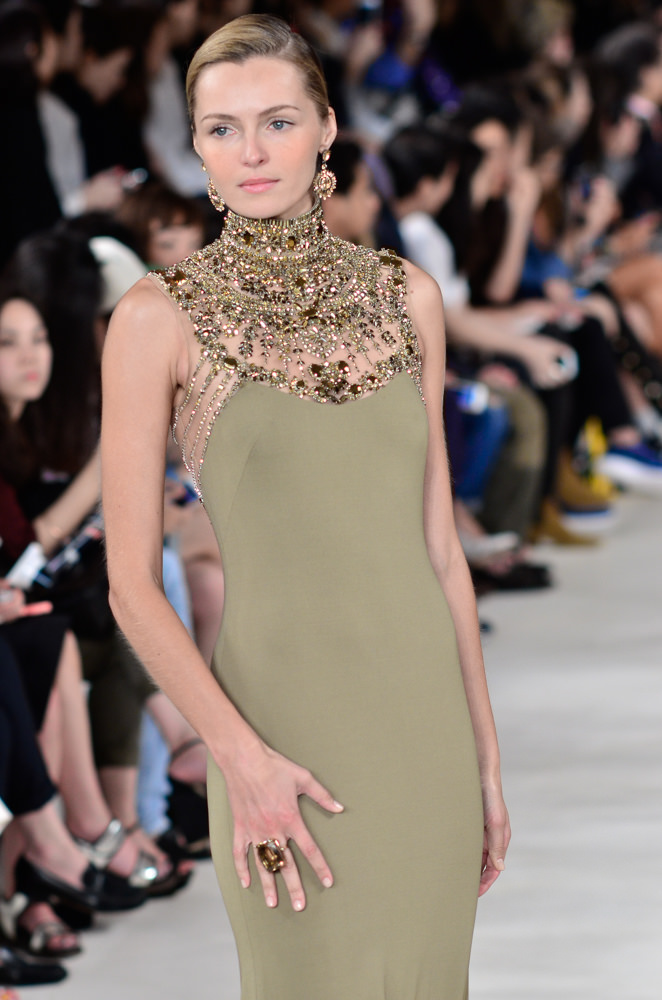
At her peak Valentina Zelyaeva walked around 50 shows in a single season — and none of that is what put her on the Forbes list. The contract did. Born in Ulan-Ude in 1982, she was signed as the face of Ralph Lauren in 2005, and the deal was renewed again and again. By 2008 Forbes ranked her the 13th highest-earning model in the world on estimated earnings of $2.3 million. Her career answers a question new models ask constantly and rarely get a straight answer to: is it better to be booked constantly, or to be locked to a single client? Zelyaeva is what the second option looks like from the inside — including what it costs.
An army family, four cities, and a girl who was not planning on this
Zelyaeva was born on 11 October 1982 in Ulan-Ude, in Buryatia, deep in southern Siberia. Her father served in the Soviet army and her mother was a school teacher, and like most military families the Zelyaevs moved repeatedly: from Ulan-Ude to Nizhny Novgorod, briefly to Leningrad, and finally to Moscow when she was seven.
By the accounts published in the fashion press, a friend passed her a modelling agency's card and she was too shy to call; her mother eventually walked her into the agency, where she was signed on the spot. She later entered Elite Model Look and did not win it. That detail is worth keeping: the contest circuit is one entry route into the business, not the entry route.
Two years in Japan — the market that teaches the job
An agent in Moscow put her on a working contract in Japan, and she took it without treating modelling as a career yet. She spent two years there, learned English, and sent money home. She has described that period as the point where the job stopped being an accident and became a profession.
The mechanic still works the same way. Tokyo and the wider Asian market are development markets: contracts there typically guarantee a fee, house the model, and fill the schedule with catalogue, commercial and beauty work. The money is rarely spectacular, but the volume is, and a new face comes home with a working book, set discipline and the ability to hit a mark without being coached. That is why agencies still send young models east before they attempt Europe — the pattern behind our guide to the Tokyo agency market. Zelyaeva was also sent to a modelling school in Milan to learn how to move in front of a camera and how to walk.
2003 to 2005: the runway years
Her New York debut came in September 2003, on the Cynthia Steffe spring/summer runway. For the autumn/winter 2004–2005 season she walked Barbara Bui, Cacharel, Calvin Klein, Chloé, Costume National, Isaac Mizrahi, Sonia Rykiel, Valentino — and Ralph Lauren.
2005 was the breakout. Across Paris, Milan and New York her show count reached roughly 50 in a season, and magazine covers became routine rather than remarkable. Two jobs from that period fixed her position, both shot by Patrick Demarchelier: the Vanity Fair portfolio "Slavs of Fashion: The New Beauties", alongside Eugenia Volodina, Natasha Poly, Carmen Kass and Karolína Kurková — a group portrait of the Eastern European wave then taking over casting — and the Pirelli calendar, where she appeared with Naomi Campbell, Adriana Lima, Isabeli Fontana and Julia Stegner.
Fifty shows a season is a punishing schedule, and it is also completely temporary. Which is what makes what happened next the interesting part.
What an exclusive contract actually is
Ralph Lauren first signed her in 2005, and then kept renewing. She is usually described as the face of the house for seven years. Alongside it she fronted two L'Oréal campaigns and worked for Tommy Hilfiger, Coach, Calvin Klein, Balenciaga, BCBG, Cole Haan and Victoria's Secret.
An exclusive is frequently misread by people entering the industry, so it is worth stating plainly. A brand exclusive is not payment for a photoshoot. It is payment for the right to stop you from working for competitors. The actual deliverable might be a handful of shooting days and the house's shows each season; the fee is for the restriction, the association and the renewal option. A day rate pays for a day. An exclusive pays whether or not the brand shoots you, and it pays again the next year if it renews.
The numbers are the point. Forbes put Zelyaeva 13th on its 2008 ranking of the world's top-earning models, at an estimated $2.3 million. In 2014 models.com still listed her among "The Money Girls". Her agent at Women Management, Chris Gay, told Forbes that a Ralph Lauren deal "is one of the greatest things you can have". For how this sits against ordinary bookings, compare the day rates in our breakdown of what models actually earn by market.
Why the contract beats the bookings
Zelyaeva has given the clearest possible reason herself: "Modeling is an industry that judges you purely by looks. Today you are on the top of your game and tomorrow a new face arrives and all eyes are on her. It happens every season."
That sentence is the whole argument for chasing a contract. Runway and editorial income is priced per day and resets to zero every season, and every season you are re-cast against people three years younger than you were last time. A renewed multi-year exclusive is the only common structure in modelling that converts a look into something resembling an annuity, because it takes the decision out of the seasonal casting lottery.
It is not free. Exclusivity blocks competitor work, which can mean turning down good money and letting a book narrow around one house's aesthetic, and it ties a career to one brand's fortunes. It is also not something a model can apply for. At 177 cm Zelyaeva sat comfortably inside standard runway range, but height was never the reason she got the deal; her clean, classic, distinctly American-sportswear look was precisely what that house sold. Casting fit, not maximum beauty, is what gets signed — which is why briefs are worth reading closely rather than answering at random, the same logic that runs through the live casting board.
New York, yoga, and an exit that was not a crash
Zelyaeva settled in New York, where the model Natasha Poly is among her closest friends. She has talked openly about managing the wear of the job: constant travel became stressful, she took a first yoga class, and started going almost every day when she was in the city. "I like to wake up at six o'clock in the morning so I have a very long morning, so I have time to meditate," she has said. "I can really tell that it makes a difference — the days I don't have meditation and the days when I do."
That interest turned into the next job. She trained and works as a health coach, writing about wellness and travel for an audience she built while modelling — a second career assembled during the first, rather than after it collapsed. Her catalogue profile sets out the career in order.