Sasha Luss walked 58 runway shows in a single autumn/winter 2013 season, added 53 more the following spring, opened her career on a catalogue shoot for a small Moscow label that Karl Lagerfeld happened to see, and then carried a $30 million Luc Besson thriller opposite Helen Mirren. Born 6 June 1992 in Magadan, 178 cm tall, she is one of the few models who converted a runway career into leading film roles rather than a brief cameo. What follows is the mechanics of that move: which parts of a modelling career transferred to a film set, which parts actively got in the way, and what it cost her in training hours.
Ballet in Magadan, then a Moscow agency at 14
Luss was born in Magadan, on Russia's Pacific coast, and later moved to Moscow with her family. As a child she had no interest in modelling - she wrote and she danced, competing in ballet until an ankle injury ended it. That matters more than it sounds: classical training gives spinal control, foot placement and an instinct for where the body is in space, and she kept all of it.
The push came from other people. Her mother's friends, then strangers, kept saying she should model, and at 14 she signed with IQ Models in Moscow. Her grandmother objected, calling modelling a terrible and immoral business. In 2007 she made her first runway appearance in Alena Akhmadullina's spring/summer show in Moscow, then signed with DNA Model Management, which flew her to Europe and New York for DKNY and Antonio Marras.
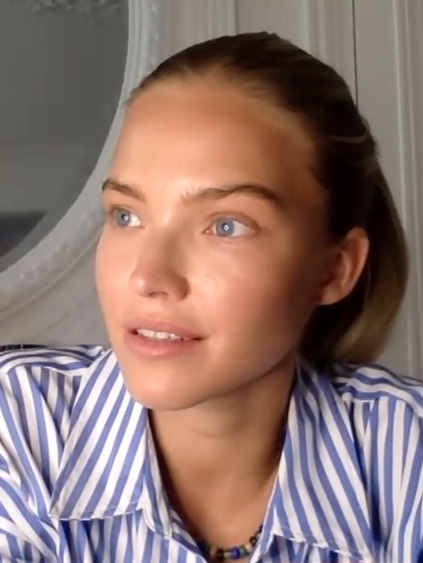
Then she did the thing scouting stories leave out: she went home to Russia to finish school. A fourteen-second clip posted to YouTube in April 2009 survives from that period - a plain agency introduction filmed against a wall, in which a sixteen-year-old Luss says: "Hello, my name is Sasha, I'm from Russia, I'm from DNA. Nice to see you and hope to see you soon. I'm 16 years old." That is a video comp card, and it is still how a new face introduces herself to a client abroad.
The catalogue Karl Lagerfeld saw
IQ Models was her mother agency until 2011, when she moved to Avant Models in Moscow and added Elite Model Management in Paris and Women Management in Milan. Around that time she shot an advertising catalogue for Bohemique, a Russian demi-couture label - an ordinary commercial job, not a fashion booking. According to media reports the images reached Karl Lagerfeld, who cast her in the Chanel Pre-Fall 2012 and Fall/Winter 2012 shows.
The following season Dior took her as an exclusive for spring/summer 2013, meaning she walked no other show. An exclusive is a deliberate trade: the model gives up a month of bookable fees for a first association with one house and the attention of every casting director watching. In her case it worked immediately.
What a peak season actually looks like
In the autumn/winter 2013 season Luss walked 58 shows, among them Prada, Valentino, Calvin Klein, Louis Vuitton and Givenchy, and models.com named her one of the season's top newcomers. She walked another 53 shows for spring/summer 2014, and Glamour Russia named her Model of the Year in 2013.
Those numbers describe a workload, not a status. Roughly four weeks across New York, London, Milan and Paris, more than fifty confirmed shows, and behind each one a casting and usually a fitting - so the real count of appointments runs into the hundreds, in sample-size clothes, with fittings finishing after midnight. It is a young person's schedule and it does not repeat many times in a career.
One decision inside that run was strategic rather than lucky: Luss bleached her hair platinum, which gave her a distinct look that designers responded to and other models copied - a reminder that appearance is a positioning choice, not just grooming. Height was never her constraint; at 178 cm she sat inside the runway band described in our height requirements guide.
Campaigns, Dior Beauty and the Pirelli calendar
Runway volume converted into paid campaigns, which is where a model's money actually is. Luss appeared in advertising for Carolina Herrera, Max Mara, Valentino and Tommy Hilfiger, starred in Chanel's spring/summer 2014 campaign, shot by Lagerfeld, and in Lanvin's, shot by Steven Meisel, and fronted Versace Jeans in autumn 2014. Her largest modelling booking was becoming a face of Dior Beauty - a beauty contract is the most durable income in the business, because it renews and pays for exclusivity rather than for days worked.
Casting director Jennifer Starr then selected her for the 2015 Pirelli calendar, shot by Steven Meisel, where Luss appeared in a retro pin-up register. By January 2015 models.com listed her among the most in-demand models, and she appeared in Vogue Italia's fiftieth-anniversary September issue.
Valerian, then Anna
Luc Besson noticed her the way fashion first did - in a photograph. By her own account in a Russian interview, he saw an image connected to a Valentino show and approached her from there. In 2017 he cast her as Princess Liho-Minaa in Valerian and the City of a Thousand Planets, a supporting, heavily stylised part.
Then came the title role in Anna (2019), a Russian agent working undercover as a model, alongside Helen Mirren, Luke Evans and Cillian Murphy. The film opened in the United States on 21 June 2019, was made for about $30 million and took roughly $31.6 million worldwide - a modest result that says more about the release than about its lead.
The preparation was not modest. According to the Los Angeles Times, Luss trained six hours a day in the months before shooting, through krav maga and kickboxing, so that both her kicks and her punches would read as an assassin's rather than a dancer's. Costume designer Olivier Beriot has said she wears 48 costumes across the film, split between the fashion world and the KGB one, with wigs changing her between blonde, red, long and short - closer to a season of shows than to a normal film.
What transfers from modelling to acting - and what does not
The sharpest observation about that transition comes from Beriot, who had to unlearn her professional habits. A supermodel, he pointed out, knows exactly how she looks in a costume and how an image is built - but a supermodel does not give advice during a fitting. She is dressed; she does not co-author. He told her they would work together and that he wanted her opinion on how a costume felt, and it changed how she worked. The difference between the two jobs sits in that exchange: modelling rewards a performer who can be shaped, acting requires one who contributes.
What did transfer was substantial - camera awareness, stamina across long shooting days, comfort taking direction from a stranger, and the physical control left over from ballet, which is why the fight choreography reads cleanly on screen. Talking about the role, Luss described the character as a person rather than an action figure: strong but real, "a killing machine in a way", yet someone who could plausibly exist.
She has kept working in film rather than treating it as a detour, co-starring in Sheroes (2023), The Last Front (2024) and the gamer thriller Latency (2024), shot in Bangkok. Fashion now visits her instead: she appeared in Vogue Hong Kong in March 2025, and has said she would walk a runway only if a close friend asked. Of the models coming up behind her, she named retouching as their central problem, and added that beauty is no guarantee of happiness. To see how a career of this shape is assembled, compare her catalogue profile with the boards in our agency directory, and start where she started - by answering live briefs on the casting board.