Posing looks effortless in finished images, but it is a learned skill. The models who book repeatedly are rarely the ones with the most striking faces; they are the ones who can give a photographer a range of usable frames quickly. The good news is that the fundamentals are simple and improve fast with deliberate practice.
Why posing matters
A photographer can light and frame you, but they cannot move your body for you. Knowing how to shift your weight, angle your limbs, and change expression on cue is what turns a shoot from a struggle into a flow. It is also what separates a portfolio that books work from one that does not — see our guide to portfolio photos for how this translates into a strong book.
The fundamentals
Start with three ideas. Posture: lengthen the spine, drop the shoulders, and lead slightly with the part of the body closest to the camera. Angles: square-on tends to flatten; turning the body even slightly creates shape. The S-curve: shifting weight to one foot and letting the hips and shoulders tilt in opposite directions creates a natural, dynamic line that reads well for both fashion and commercial work. Almost every strong standing pose is a variation on these three principles.
Working with the camera and the lens
Where the camera sits changes everything. A lens slightly above eye level tends to be flattering; very low angles can distort. The part of you closest to the lens looks largest, so pushing a shoulder or chin toward the camera, or away from it, changes your proportions in the frame. Learn to notice where the lens is and adjust to it rather than posing the same way regardless. Creating a little space between your arms and your torso, rather than pressing them flat against your body, keeps the silhouette clean.
What to do with your hands
Hands are where most beginners freeze. The rule of thumb is to keep them relaxed and avoid the extremes — no stiff fingers, no clenched fists. Light contact gives hands a job: resting on a hip, grazing the hair, touching the collar, or holding a prop. Soft, slightly separated fingers photograph better than a flat, tense hand, and showing the side of the hand rather than the back is usually more elegant. The same logic applies to feet: a slight point or a turned angle reads better than flat and square.
Face and expression
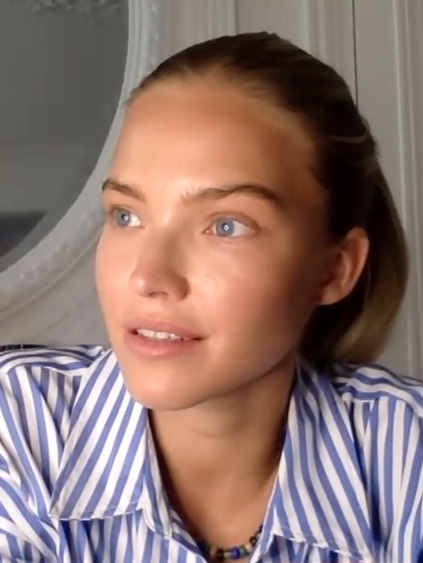
Expression carries an image. Practice small adjustments in a mirror: a relaxed jaw, a slight squint to the eyes (often called smizing) for intensity, and genuine micro-smiles rather than a fixed grin. The chin is a powerful tool — pushing it slightly forward and down defines the jawline and avoids a flattened look. Vary expression frame to frame so the photographer has range to choose from, and remember that the eyes do most of the work; a thought behind them reads on camera far more than a posed face.
Posing for different kinds of work
Match the energy to the job. Editorial rewards bold, expressive, sometimes unconventional shapes. Commercial wants warmth and approachability — relaxed, natural, smiling. E-commerce prioritises clear, repeatable poses that show the garment cleanly, often the same few angles for every item. Knowing which register a shoot calls for, which is usually clear from the casting brief, lets you adapt instead of giving the same look every time.
Full body, portrait, and movement
Different crops call for different thinking. For full-body shots, the whole silhouette matters — weight, leg position, and the line from head to feet. For portraits, small shifts of the head, shoulders, and chin carry the image. Adding gentle motion — walking, turning, adjusting the hair, letting fabric move — produces more natural frames than holding rigid poses, which is why photographers often ask you to keep moving slowly while they shoot.
Flattering angles and body types
There is no universal best pose, but there are reliable principles: create separation so limbs read as distinct lines, turn rather than face square-on, and elongate by lengthening the neck and pointing through the feet. The goal is not to hide anything but to present a clean, intentional line. Studying which angles work for your own proportions, in the mirror and on camera, is more useful than copying a pose that suited someone built differently.
How to practice
Pose in front of a mirror and a phone camera regularly. Study how professional images in your target category are composed and try to recreate the shapes. Film yourself moving slowly between poses so you learn to transition smoothly rather than freezing between frames. Over time, a personal library of go-to poses becomes muscle memory you can draw on under pressure on set, which is exactly what makes a model easy and quick to shoot.
Posing with props and wardrobe
Props and clothing give your hands and body a purpose, which instantly relaxes a stiff pose. Hold a bag by the handle rather than gripping it, let a jacket hang off one shoulder, rest a hand lightly in a pocket with the thumb out. The point is interaction that looks incidental, not staged. With flowing fabric, gentle movement — a slow turn, a soft toss — creates shape the camera can catch. Let the wardrobe lead the pose rather than forcing a pose around it.
Posing with others and in groups
Group and couple work adds a layer: you are composing with other people, not just yourself. Vary heights and levels so everyone is not standing in a flat line, leave small gaps so each person reads as distinct, and angle bodies slightly toward one another to suggest connection. Be aware of where everyone's hands and eyelines go. The same fundamentals apply — posture, angles, relaxed hands — but the goal shifts toward a balanced composition where no one is hidden and the group feels natural together.
Frequently Asked Questions
How can I practice posing at home?
Use a mirror and your phone camera, recreate poses from images in your target category, and film slow transitions between poses to build smooth movement and a personal go-to library.
What should I do with my hands when modeling?
Keep them relaxed with softly separated fingers and give them a purpose — resting on a hip, touching the hair or collar, or holding a prop. Avoid stiff fingers and clenched fists.
Do commercial and editorial poses differ?
Yes. Editorial rewards bold, expressive shapes; commercial work wants warm, natural, approachable poses; e-commerce favours clean, repeatable poses that show the clothing clearly.
What is the S-curve in posing?
It is shifting your weight onto one foot so the hips and shoulders tilt in opposite directions, creating a natural curved line through the body that photographs more dynamically than standing square-on.
How do I look natural instead of stiff in photos?
Keep gently moving rather than holding rigid poses, breathe and relax your jaw, and think a real thought behind your eyes. Small continuous adjustments produce more natural frames than freezing in one position.